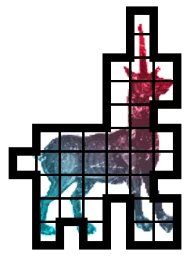

Porous Stack
Discrete aggregation of cylindrical modules using WFC
by Myroslava Kudelia & Olha Kozachenko, Kharkiv School of Architecture, 2025
Tutor: Anton Klyshnia
Porous Stack explores discrete aggregation through cylindrical modules assembled using Wave Function Collapse. Developed as part of the Discrete Aggregations course at the Kharkiv School of Architecture, the project uses Monoceros to generate compositions that range from compact clusters to elongated towers and sprawling horizontal formations - all from the same set of modules and rules.
The module system consists of cylinders of varying diameters and heights, color-coded by function. Adjacency rules govern how modules connect - which sizes can stack, which can sit side by side and where transitions occur. The WFC solver produces unexpected yet structurally coherent arrangements, with each configuration expressing a different spatial character while maintaining the porosity that gives the project its name.
The digital aggregations were verified through physical models built from painted cardboard tubes, then activated as ikebana vessels with dried flowers - a deliberate translation from rule-based geometry to lived material object. The result is an ikebana-like language of stacked volumes, where computational rules and material intuition converge.

Digital aggregation studies


Process animations





Physical model


